
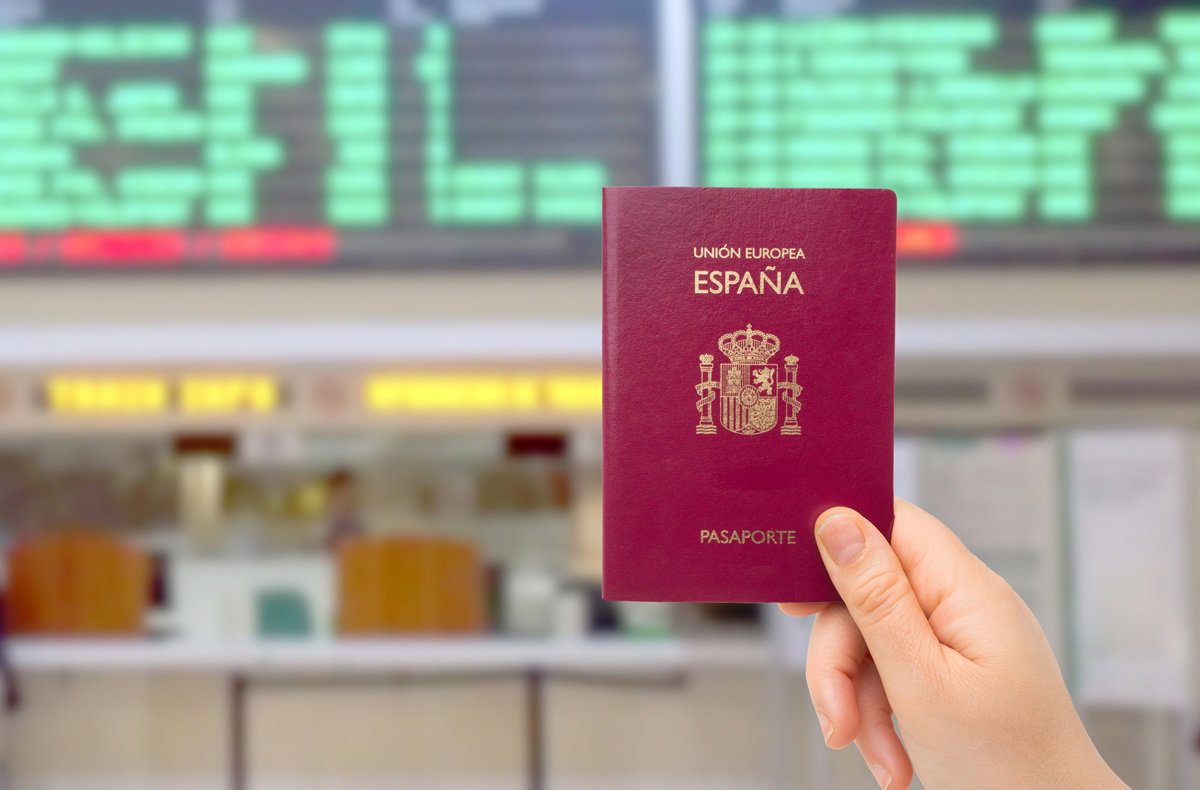
A Spanish passport pictured at an airport as 2026 rankings highlight Spain’s travel edge over the UK after Brexit.
Credit : cunaplus, Shutterstock
If you simply take a look at the raw passport rankings, the gap between Spain and the UK in 2026 doesn’t look dramatic. In the newest Henley Passport Index, Spain sits among the many world’s strongest passports with access to 185 destinations and not using a visa prematurely, while the United Kingdom follows closely behind on 183. On paper, that could be a difference of just two destinations.
But that tiny gap hides a much larger story. Because for Spanish passport holders, the actual advantage in 2026 isn’t simply about ticking off a pair more countries on a map. It is about what comes with being an EU citizen. And that is strictly where Brexit modified the image for Britons.
The result’s that a Spanish passport today offers something a British one not can: not only easy holidays abroad, but the proper to maneuver, live, work and settle freely across much of Europe without visas, permits or immigration formalities. For Britons, that freedom disappeared with Brexit.
Spain still travels near the highest of the world’s passport rankings
The latest 2026 passport tables once more place Europe among the many global mobility heavyweights. Henley’s April update keeps Singapore in first place, while Spain stays in the highest tier alongside a cluster of European countries including France, Germany, Italy and Switzerland.
The UK remains to be very strong by global standards. British passport holders can travel visa-free, or without getting a visa before departure, to 184 destinations in line with Henley. That is hardly a weak travel document. In fact, hundreds of thousands of passport holders world wide would gladly swap for that level of access.
But rankings only tell a part of the story. A passport index measures short-term travel freedom. It tells you where you may go for a visit without applying for a visa prematurely. What it doesn’t fully capture is the difference between being allowed to go to somewhere and being free to construct a life there and that’s where Spain pulls away.
What Spanish passport holders can try this Britons can not do
A Spanish passport does not only open borders for tourism. It also comes with EU citizenship rights, and that changes every little thing.
A Spaniard can move to France, Germany, Italy, the Netherlands or Ireland and, broadly speaking, live there without applying for a piece visa first. They can take a job, register as a resident, study, retire, open a business or relocate with far less bureaucracy than a non-EU national. They also keep access to freedom of movement across the EU and the broader European Economic Area, subject to local registration rules once they stay long run.
A British passport holder not has that automatic right.
That is the actual post-Brexit divide. Before the UK left the EU, Britons had the identical broad freedom of movement rights as Spaniards do now. A British citizen could move to Spain, find work, settle in France or retire to Portugal under the identical European framework. That framework is gone.
In 2026, a Briton can still go to Spain for a vacation and not using a visa. But wanting to remain, work, study for an prolonged period or move permanently is a totally different matter. It now means coping with the immigration rules of the destination country quite than counting on EU free movement.
For British holidaymakers, Brexit didn’t shut the door to Europe. For British residents who wanted Europe as a spot to live or work, it absolutely modified the lock.
Brexit didn’t destroy the British passport – it modified what ‘travel freedom’ really means
One of the best mistakes to make with passport rankings is assuming that a passport’s ‘power’ is nearly what number of flags you may collect and not using a visa sticker. That makes for a neat league table, nevertheless it misses how people actually use mobility.
For many British readers, the most important post-Brexit change has not been a sudden inability to travel. It has been the slow pile-up of additional friction.
British travellers aren’t any longer treated like EU residents at European borders. They can face separate queues, passport stamping and tighter checks on how long they’ve stayed within the Schengen area. The familiar 90 days in any 180-day period rule now matters in a way it never used to. For second-home owners, distant employees, long-stay visitors and other people who split their yr between countries, that change has been particularly significant.
There are also practical irritations which have turn out to be a part of post-Brexit travel: stricter passport validity rules for entry into some European countries, the top of the old assumption that moving across the EU can be largely frictionless, and a growing list of admin-heavy situations that didn’t exist when the UK was still contained in the bloc.
Spanish passport holders simply don’t take care of Europe in the identical way. They usually are not third-country travellers once they move across the EU. Britons are.
And that distinction matters greater than whether one passport ranks fourth and the opposite sixth.
The British passport remains to be strong – just not in the identical way
None of this implies the British passport has turn out to be weak. It hasn’t.
The UK still sits comfortably in the worldwide top tier. British passport holders proceed to enjoy excellent access worldwide, and in lots of day-to-day travel situations the difference between Spain and the UK is barely noticeable. A vacation in Thailand, a city break in New York or a visit to much of Latin America isn’t suddenly unimaginable due to Brexit.
But the old version of British mobility was larger than tourism. It included the proper to treat Europe not as a foreign destination, but as an extension of home territory for work, life and family plans. That is what has modified.
Spain, against this, still offers each layers of mobility without delay. There is the passport strength itself, which stays among the many world’s best, after which there’s the added value of EU citizenship. That combination is what makes the Spanish passport especially powerful in 2026.
It is why two countries can sit near one another within the rankings while offering very different real-world freedoms.
So who really has the higher deal in 2026?
If the query is only about short trips, the reply is that each Spanish and British passport holders remain in a really privileged club. The gap is narrow and each passports open a big a part of the world.
But if the query is broader – who has more freedom to make use of Europe as a spot to live, work, settle and move around with minimal red tape – then Spain wins by a distance.
That is the quiet truth behind the 2026 passport rankings. Brexit didn’t make the British passport collapse. It made it narrower.
Spanish passport holders still enjoy what Britons once had: a robust passport backed by the proper to maneuver freely across the European project. British travellers can still board the plane. What they lost was the power to land in much of Europe and treat it as a spot they might simply get on with living in.
And in 2026, that matters way over two extra visa-free destinations.
Escape the ordinary and discover the extraordinary! From bustling cities to serene landscapes, every journey begins with a single step—let us guide yours. Enjoy curated itineraries, hidden gems, and hassle-free bookings designed for explorers at heart. Whether it's a weekend getaway or a globe-trotting adventure, your Next unforgettable experience is just a click away.